


19 Oct 2026 · 8 min read
Getting Your Car Fixed in Santa Ana: A 2026 Neighborhood Guide
A category-by-category look at where Santa Ana drivers go for repair, tires, brakes, transmissions, body work and glass in 2026.
santa ana california auto repair29 September 2026 · 8 min read
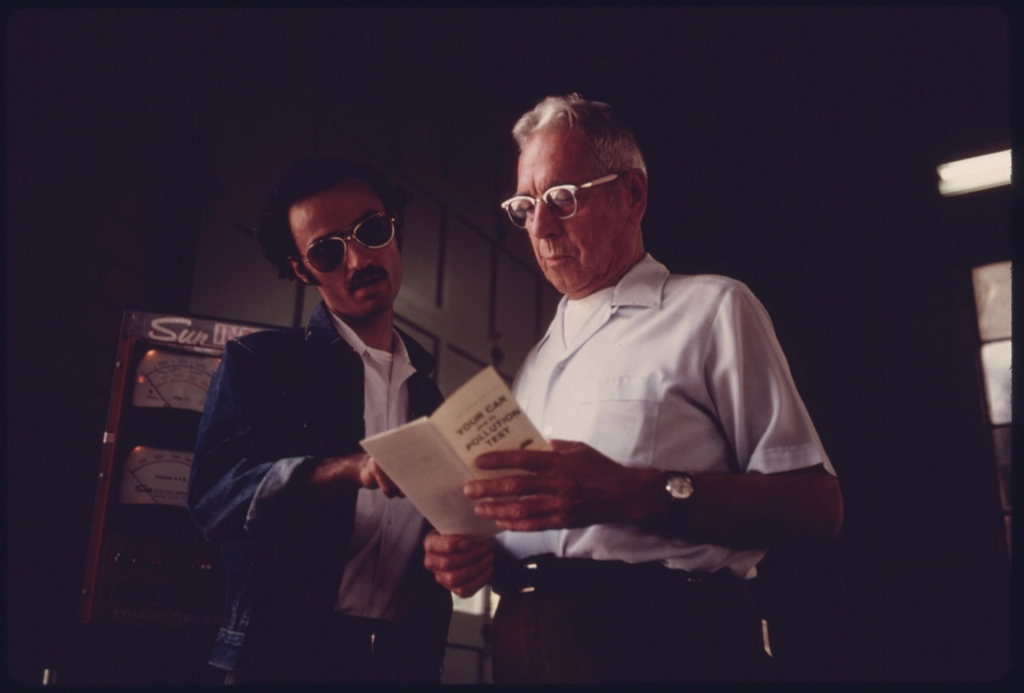
Every couple of years, California drivers get the same postcard from the DMV: it's time for a smog check. For a rule that touches millions of vehicle registrations, the details — who's exempt, how often testing is really required, and what a STAR station is — are easy to get wrong. Here's what the state's own rules say for 2026, and where to get tested if you're due.
California's Smog Check program exists to keep vehicle emissions in check in the counties with the worst air quality. Not every county participates — the program applies in a set of designated smog-check counties that includes the state's major metro areas, from Los Angeles and San Francisco to Fresno and San Diego. If you register a vehicle in one of those counties, a smog check is generally required at registration renewal, on transfer of ownership, and when a vehicle is first registered in California from out of state.
The program is run jointly by the Department of Motor Vehicles (DMV), which handles registration, and the Bureau of Automotive Repair (BAR), which licenses and audits the stations that actually perform the testing. The DMV notifies you by mail or through its online registration renewal system when a smog check is due, and that notice will also tell you whether you need a regular station or a STAR station.
The exemptions are the part most drivers get wrong. Under current BAR and DMV rules:
| Vehicle type | Smog check status |
|---|---|
| Gasoline/hybrid, 1976 or newer | Required (unless newer than 8 model years — see below) |
| Gasoline/hybrid, 1975 or older | Exempt |
| Diesel, 1998 or newer, under 14,000 lbs | Required |
| Diesel, 1997 or older, or over 14,000 lbs | Exempt |
| Fully electric | Exempt |
| Motorcycles | Not covered by the program |
For vehicles that aren't exempt, testing at registration renewal happens every other year (biennial). But there's a wrinkle that trips people up: vehicles eight model years old or newer don't need an actual test at renewal. Instead, the registered owner pays a smog abatement fee in place of the inspection. To find out when a car will need its first real test, add eight to the model year — a 2026 model-year vehicle, for example, won't need its first biennial Smog Check until 2034.
There's a separate, shorter grace period for change-of-ownership testing: vehicles four model years old or newer don't need a smog check when the vehicle changes hands; the buyer pays a transfer fee instead. For a 2026 model-year vehicle, that exemption runs through 2030.
Smog Check & Vehicle Inspection · San Jose, California
Not all smog check stations are the same, and the DMV notice you receive will specify which type you need:
If your renewal notice says you need a STAR station, an ordinary test-and-repair shop that isn't STAR-certified can't complete your inspection, so it's worth confirming a station's certification before you drive over.
Smog Check & Vehicle Inspection · Santa Monica, California
Smog Check & Vehicle Inspection · San Diego, California
A Smog Check inspection has two parts. On vehicles from model year 2000 and newer, technicians primarily run an OBD (on-board diagnostics) check, plugging into the vehicle's computer to confirm the emissions-control systems are present, communicating, and not reporting stored fault codes. Older vehicles without a compatible OBD system instead get a tailpipe emissions test on a dynamometer, measuring actual exhaust output against state limits for the vehicle's class.
Either way, the technician also does a visual and functional check of emissions-related components — the catalytic converter, gas cap, fuel evaporative system, and check-engine light, among others. A check-engine light that's on, or a gas cap that doesn't seal, is one of the more common and least expensive reasons a car fails that a driver can sometimes catch before paying for a test at all.
The state sets a flat $8.25 Smog Check certificate fee that's added on top of whatever a station charges for the inspection itself. Inspection prices vary by station, by vehicle type, and by whether the shop is running a promotion, so check current rates directly with the station rather than assuming a set number. If your car needs a smog abatement fee instead of a test (the 8-model-year rule above), that fee is paid through the DMV at registration renewal, not at a smog station.
Drivers who can't afford repairs to pass a smog check, or whose vehicle is a chronic high polluter, may qualify for BAR's Consumer Assistance Program, which offers repair cost assistance or a payment toward retiring the vehicle for income-eligible applicants.
A failed smog check isn't the end of the process. If a test-and-repair station performed the inspection, they can typically quote and complete the needed emissions repairs directly. If you used a test-only station, you'll need to take the vehicle to a licensed repair shop — many general repair shops, not just dedicated smog stations, are equipped to do emissions-related diagnosis and repair.
If you believe a test result was incorrect, or you're having trouble getting a vehicle to pass after repairs, BAR's Referee Program exists specifically to arbitrate disputed results and verify emissions-control equipment. It's a state resource, not the testing station, so it's a useful next step when a car keeps failing for reasons that don't add up.
Smog Check & Vehicle Inspection · Glendale, California
The directory carries hundreds of smog check and vehicle inspection stations across California, and a handful of the state's busiest — measured by review volume — sit in cities the site already covers in depth. In San Jose, 1025 Star Smog Station is one of the highest-volume stations in the local vehicle inspection category. Santa Monica drivers have a STAR-certified option in Santa Monica Smog Check STAR Certified, useful if your DMV notice specifically requires a STAR station.
San Diego has multiple long-running test-only stations, including 3B Smog Check Station; browse the full San Diego vehicle inspection listings for others nearby. In the San Fernando Valley and Glendale area, Arco Highland Smog Pros combines fuel service with testing. Berkeley drivers can pair a smog check with registration paperwork at Berkeley Smog and DMV Registration Service, and Pasadena has a dedicated test-only option in All Smog Test Only Star Station, part of the broader Pasadena auto services directory.
Smog Check & Vehicle Inspection · Berkeley, California
Smog Check & Vehicle Inspection · Pasadena, California
The change-of-ownership rule catches a lot of private-party buyers and sellers off guard. Unless the vehicle is four model years old or newer (in which case the buyer just pays a transfer fee), California law requires the seller to provide a valid smog certification at the time of sale. That means if you're selling an older car, budget for a smog check before you list it — a failed test discovered mid-sale can stall or unwind a deal. If you're buying a used car privately, ask to see the certificate rather than assuming it's been handled; dealers licensed to sell used vehicles typically handle this as part of the sale, which is one practical difference between buying from a private party and buying from an established car dealer.
A few misconceptions come up often enough to be worth correcting directly:
Before your next renewal notice arrives, it helps to know where your vehicle stands:
The takeaway: most California drivers with a car newer than eight model years won't see an inspector at all this cycle — just a fee. For everyone else, the biggest cost of a smog check is usually confusion about station type, not the test itself. Confirming what your DMV notice actually requires before you book an appointment saves a wasted trip.
19 Oct 2026 · 8 min read
A category-by-category look at where Santa Ana drivers go for repair, tires, brakes, transmissions, body work and glass in 2026.
santa ana california auto repair
18 Oct 2026 · 7 min read
What sets diesel engine service apart in 2026, the problems Houston diesel owners run into most, and how to find a shop equipped to handle them.
houston texas diesel repair
17 Oct 2026 · 8 min read
What pulling, uneven tire wear and an off-center steering wheel mean, and how Anaheim drivers can get an alignment checked and fixed.
anaheim california wheel alignment